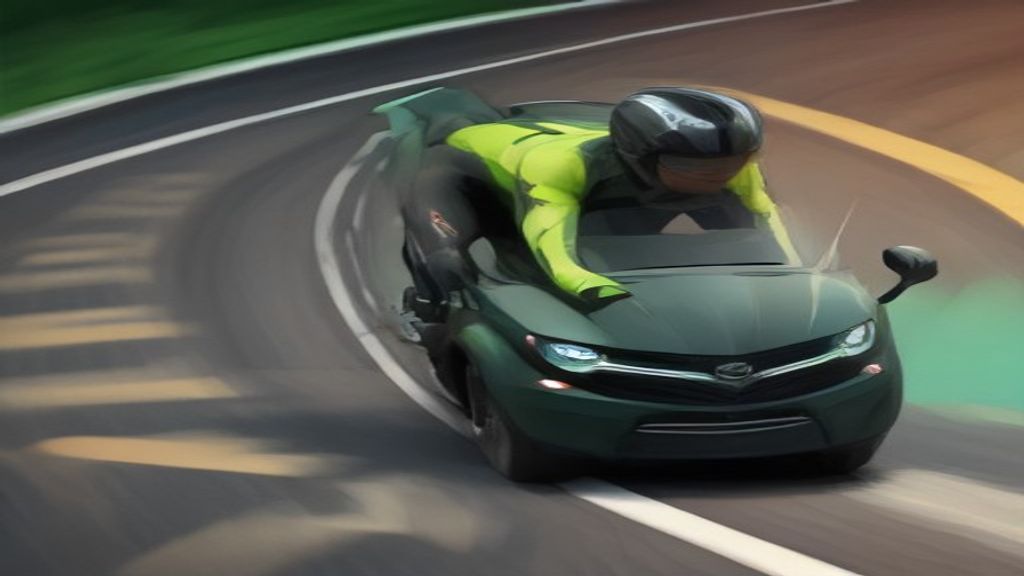
Ever wondered why a car’s speedometer shows a number, but the GPS tells you you’re moving north at 60 km/h?
Speed tells you how fast something is moving, velocity adds the direction, and acceleration tells you how quickly the speed or direction is changing. Think of a bike ride: the faster you pedal, the higher the speed; the direction you turn is part of velocity; and how quickly you speed up or slow down is acceleration.
What is Speed?
Speed is simply the distance covered per unit of time. It’s a scalar quantity, which means it has only magnitude (how much) and no direction. If you run 100 meters in 20 seconds, your speed is 5 m/s (meters per second). The formula is:
Speed = Distance ÷ Time
What is Velocity?
Velocity is speed with a direction attached. Because it’s a vector (something that has both size and direction), we write it as, for example, 5 m/s east. If you walk 100 m north in 20 s, your velocity is 5 m/s north. The same distance covered in a different direction gives a different velocity even though the speed is the same.
The basic formula looks the same as speed, but we always include a direction:
Velocity = Displacement ÷ Time
Notice the word *displacement* – that’s the straight‑line distance from the start point to the end point, not the total path length.
What is Acceleration?
Acceleration measures how quickly velocity changes. It can be a change in speed, a change in direction, or both. If a car goes from 0 to 20 m/s in 4 seconds, its acceleration is 5 m/s² (meters per second squared). The unit “per second squared” tells you how much the speed increases every second.
Formula:
Acceleration = Change in Velocity ÷ Time
Again, because velocity is a vector, acceleration is also a vector. Turning a corner at a constant speed still means you have acceleration because the direction is changing.
How Speed, Velocity and Acceleration Relate
Think of water flowing through a pipe. The amount of water that passes a point each second is like speed – just a number. If you point the pipe north, you’ve added a direction, making it like velocity. If you suddenly open the tap wider, the water rushes faster; that rush is acceleration.
In physics, these three concepts sit on a simple hierarchy:
- Speed – how fast, no direction.
- Velocity – speed + direction.
- Acceleration – how fast the velocity itself is changing.
Worked Example: A Bike Trip
Riya rides her bike from point A to point B, 150 m east, in 30 s. She then turns north and rides another 100 m in 20 s. Find her average speed, average velocity, and acceleration if she speeds up uniformly from rest to her final speed in the second leg.
- Average speed: Total distance ÷ total time = (150 m + 100 m) ÷ (30 s + 20 s) = 250 m ÷ 50 s = 5 m/s.
- Average velocity: Net displacement (straight line from start to finish) is a right‑triangle: 150 m east and 100 m north. Using Pythagoras, displacement = √(150² + 100²) ≈ 180 m. Direction = tan⁻¹(100/150) ≈ 34° north of east. So average velocity = 180 m ÷ 50 s = 3.6 m/s at 34° north of east.
- Acceleration during second leg: She starts the northward leg from rest (0 m/s) and reaches a speed of (distance ÷ time) = 100 m ÷ 20 s = 5 m/s north. Change in velocity = 5 m/s (north) – 0 = 5 m/s. Time = 20 s, so acceleration = 5 m/s ÷ 20 s = 0.25 m/s² north.
Quick Comparison Table
| Concept | Type | Formula | Units | Key Feature |
|---|---|---|---|---|
| Speed | Scalar | Distance ÷ Time | m/s | No direction |
| Velocity | Vector | Displacement ÷ Time | m/s | Includes direction |
| Acceleration | Vector | Change in Velocity ÷ Time | m/s² | Change of speed or direction |
📝 Likely Exam Questions
- Define speed, velocity and acceleration. State whether each is a scalar or vector.
Answer: Speed – scalar, distance/time. Velocity – vector, displacement/time with direction. Acceleration – vector, change in velocity/time. - A car travels 60 km north in 2 h and then 80 km east in 1 h. Find its average speed and average velocity.
Answer: Total distance = 140 km, total time = 3 h → average speed = 46.7 km/h. Displacement = √(60²+80²)=100 km at tan⁻¹(80/60)=53.1° east of north → average velocity = 33.3 km/h at that direction. - If a ball rolls down a slope and its speed increases from 2 m/s to 8 m/s in 3 s, calculate its acceleration.
Answer: Δv = 6 m/s, t = 3 s → a = 2 m/s² (down the slope). - Explain why a car moving at constant speed around a circular track is accelerating.
Answer: Although the speed is constant, the direction continuously changes, so velocity changes. Changing direction means acceleration toward the centre (centripetal acceleration).