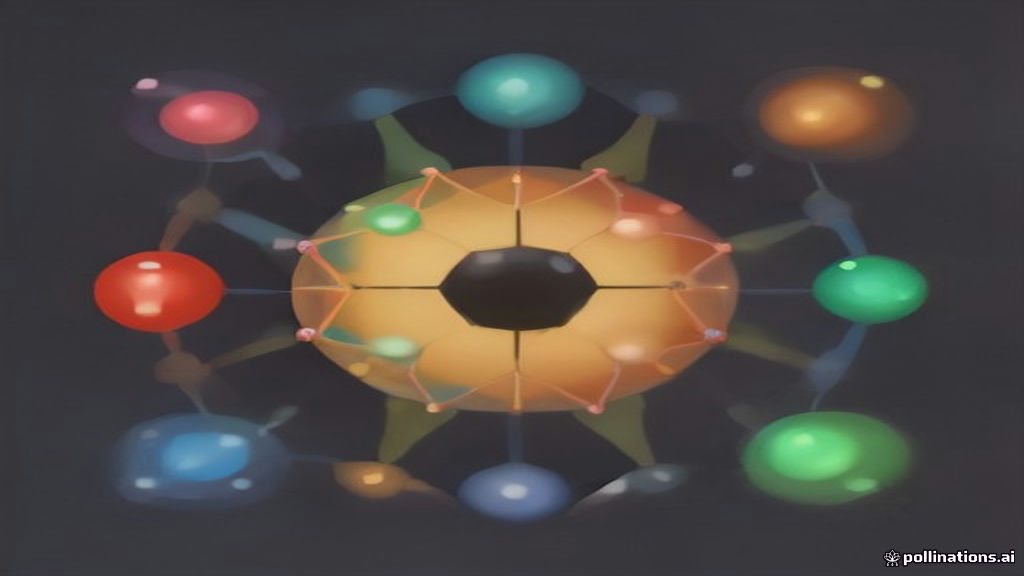
What is Chemical Bonding and Molecular Structure?
Everything around us—water, sugar, plastic—is made of atoms that stick together. The way they join up is called chemical bonding, and the shape they adopt is the molecular structure.
💡 In Simple Words: Atoms are like tiny magnets. When they attract each other, they form bonds, and the whole group arranges itself in a shape that fits best, just like friends forming a circle.
Types of Chemical Bonds
A bond tells us how electrons (tiny negatively‑charged particles) are shared or transferred between atoms.
Ionic Bond
An ionic bond forms when one atom gives an electron to another, like a kid handing over a baseball. The donor becomes positively charged (cation) and the receiver becomes negatively charged (anion). The opposite charges pull them together.
Covalent Bond
In a covalent bond, atoms share electrons, similar to two people holding the same umbrella. If they share one pair, it’s a single bond; two pairs make a double bond; three pairs a triple bond.
Metallic Bond
Metals have a sea of delocalised electrons—imagine a crowd of people passing a ball around freely. This “electron sea” glues the metal atoms together and gives metals their shine and conductivity.
Molecular Geometry – Why Shape Matters
The arrangement of atoms in space decides many properties—boiling point, reactivity, colour. To predict shape we use the VSEPR theory.
VSEPR Theory (Valence Shell Electron Pair Repulsion)
VSEPR says electron pairs around a central atom repel each other and try to stay as far apart as possible, just like friends spreading out on a bench.
Common Shapes
- Linear: 2 atoms, 180° (e.g., CO₂)
- Trigonal planar: 3 atoms, 120° (e.g., BF₃)
- Tetrahedral: 4 atoms, 109.5° (e.g., CH₄)
- Trigonal bipyramidal: 5 atoms (e.g., PCl₅)
- Octahedral: 6 atoms (e.g., SF₆)
Hybridisation – Mixing Orbitals
When atoms form bonds, their atomic orbitals (regions where electrons live) can mix to create new shapes called hybrid orbitals. For example, carbon in methane (CH₄) uses sp³ hybridisation—one s and three p orbitals combine to give four equivalent orbitals pointing to the corners of a tetrahedron.
Comparison of Bond Types
| Bond Type | Electron Movement | Typical Properties |
|---|---|---|
| Ionic | Electron transfer | High melting point, soluble in water, conduct electricity when molten |
| Covalent | Electron sharing | Variable melting points, poor conductors, often gases or liquids |
| Metallic | Delocalised electron sea | Conduct electricity, malleable, shiny |
Quick Summary
- Bonding is the way atoms stick together; structure is the 3‑D shape.
- Ionic = transfer, Covalent = share, Metallic = electron sea.
- VSEPR helps predict shape by counting electron pairs.
- Hybridisation explains why shapes like tetrahedral appear.
📝 Likely Exam Questions
- Explain why NaCl has a high melting point.
Na⁺ and Cl⁻ ions are held together by strong electrostatic forces; a lot of energy is needed to break them. - Draw the Lewis structure of CO₂ and state its molecular geometry.
C double‑bonded to two O atoms; linear geometry with 180° bond angle. - What is sp³ hybridisation and which molecule is a classic example?
Mixing of one s and three p orbitals to form four equivalent orbitals; methane (CH₄) is the example. - Compare the properties of ionic and covalent compounds.
Ionic compounds: high melting points, soluble in water, conduct electricity when molten. Covalent compounds: lower melting points, often non‑conductive, solubility varies. - Using VSEPR, predict the shape of NH₃ and give its bond angle.
Three bonding pairs and one lone pair → trigonal pyramidal shape; bond angle ≈ 107°.